Four months ago, I started learning Swedish in earnest. It’s been one of those things that feels absolutely inevitable but, more than that, it’s been unexpectedly satisfying brain candy. After so many astoundingly mediocre stabs at Romance languages that had me convinced I am hopelessly doomed to monolingualism forever, it turns out that Germanic ones—at the very least, the song of my heritage—scratch that former-G&T-kid-need-for-escalating-validation itch that I’ll apparently never totally be free of.
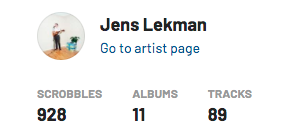
I’ve been enjoying the experience so much that I started looking for Swedish music in the hopes of attempting language immersion, partly inspired by snippets of the linguistically adjacent-ish Sigur Rós feeling more and more accessible and increasingly less like gobbledigook. So on the post-ides side of mid-March, a little bit of casual googling led me to When I Said I Wanted to Be Your Dog, Jens Lekman’s first album and an absolute failure in my initial mission that paid off beautifully, heralding one of the most auspicious new-to-me music discoveries I’ve made since hubs’ closest buddy introduced me to the songs of Paul Curreri a few years ago; two more albums later, I was riding that deliriously joyful high of falling in love at first listen.
Whenever I start digging into a well-established discography, I try to make my way through the extant catalog in chronological order, partly because I want to experience its progression as naturally as a retrospective romp allows but also because I have a tendency to glom onto the later stuff at the exclusion of earliest albums. And Lekman’s aforementioned debut album proper made for a lovely, invitingly vulnerable introduction to a cache of music I had no idea would demand all the attention I freely gave it.
Appropriately for a couple of professional word-slingers who first met through their college newspaper, my husband’s been a writer for longer than we’ve been together, and has spent the past decade-plus in the outdoors niche; I’ve picked up the periphery knowledge that arrives on sharing a field with your life partner and talking shop with publication-specific vernacular and examples. One of those kernels of surprisingly illustrative, infinitely transferrable wisdom is that the woods are “flat” when you first see them, an indistinguishable blur of twisting branches wholly devoid of any defining characteristics until you’ve settled in, taken stock of your surroundings, and put in the effort to get to know them and their dimensionality. You have to pay attention and move around a bit until you can, as the saying goes, actually see the forest for the trees.
Ever since first learning of and especially since paying attention to the practical experience of that phenomenon, it’s the first place my thoughts go whenever a collection of music—whether it’s an album becoming less a tangle of songs and more the cohesive sum of its parts, or an oeuvre sounding less like a pile of albums and more a progression of sound and well-defined stops along the journey from its first recording to its most recent one—starts to develop those identifying nuances of being known. That process of feeling my way around a catalog of sound until it’s as familiar and as mine as anything I’ve ever summoned from my own inner landscape is one of the best parts of discovering something new that hits all the right notes, a visceral reminder that loving anything is a verb and that anything worth loving will, in its own way, return whatever you put in.
And as I went from the giddy awe of digging into music that unyieldingly gave me everything I didn’t even know I wanted to belting out lyrics that felt so inexplicably, intimately inviting that their company made standstill rush-hour traffic an infinitely more enjoyable experience than it ever has any right to be, favorite songs emerged and familiar geographies took shape.
Retrospectively, When I Said I Wanted to be Your Dog now feels unmistakably like a first album in the best way possible, an introduction of themes establishing a foundation for what’s to come. When I first heard it, it was everything I want from a singer-songwriter, with just enough earworms and quirkiness and heart and good fucking lines and welcoming hidey-holes of musical nooks for me to personalize and summarily love; now, it sounds a lot more acoustic and subdued (but no less charming) than my first impression registered, but it is unfair to ask an album to be 41 minutes of “You are the Light (by which I travel into this and that),” so named for a poem I keep meaning to investigate further but very much have not.
(It is, perhaps, also unfair to let one song either define an entire or dominate the rest of its album, but “You are the Light” really got under my skin in a for-keeps kind of way, and I grew to love it even more after the name-drop it got a few albums later because I am an absolute sucker for that meta shit.)
After taking When I Said I Wanted to be Your Dog for a spin and falling hopelessly in love, I gave Night Falls Over Kortedala a listen and… holy shit. Just holy fucking shit. If the first album was a promising introduction, that second one was falling wildly, recklessly head-over-heels in love.
And, like the early days of adulthood should have taught me to get used to, my timing couldn’t’ve been any maddeningly worse. Look, here’s my shitty timing as a bar chart:
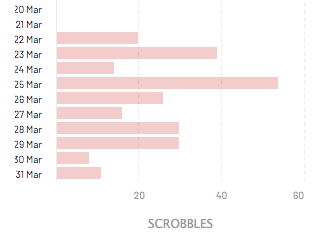
I first gave Lekman’s music a shot with the trio of When I Said I Wanted to be Your Dog, Night Falls Over Kortedala and Correspondence, Lekman’s 2019 letters-as-songs collaboration with Annika Norlin, on March 22; unbeknownst to me, a week or so earlier, Lekman had announced he was discontinuing Night Falls Over Kortedala, earmarking it for removal from purchasing platforms and streaming services for reasons not initially clarified on March 21, completely undermining my attempt to buy a copy of it two and a half songs in like my knee-jerk responses wanted to. I still have no idea how or why it lingered on Spotify for a day longer, but it did and I was heartbroken to find that the next morning’s insomnia wouldn’t be the one-person listening party I was hoping for. But I had gotten one good listen in and that was enough to hunt down a secondhand CD because fuck yes, I needed this album for infinite-repeat listens.
In the interminable wait for an Australia-dispatched CD to finally land in my U.S. East Coast mailbox in these times of everything operating on a delay (which is the entire reason this post percolated for weeks), I soaked up everything else I could, snatching up physical CDs and settling for digital purchases when I had to, learning every album’s personality and the reasons to love them for their places in a musical output I’m woefully late to appreciating but gratefully drinking in with the gobsmacked, reverent awe that only a tardy arrival’s need to make up for lost time can inspire. At least no one can cram a decade of love into a considerably more abbreviated timeframe like I can (so don’t tell me a lifetime of lovingly honed procrastination isn’t an art with untold benefits liberally sprinkled along the way).
By the time Night Falls Over Kortedala finally arrived last week (which Australia Post helpfully announced via one very perky email!), I’d gotten to know the five other newest additions to my music library with almost a month’s head start. Since any attempt at meaningful chronology was out the window with Album No. 2 moving at the speed of pandemic-delayed international postage, I gave up and jumped to his newest album on Spotify. But Correspondence just didn’t stick the way all the others have: It was just a little too steeped in winter sounds at a time when I am desperate for every scrap of proof that the spring thaw is coming. It’ll be prime for a post-summer revisit anyway, since there was actually a lesson to be learned in the old-fashioned art of patiently waiting out snail mail’s gift of incoming CDs: Nothing prolongs the joy of a new favorite like forcibly pacing yourself rather than devouring it all at once, an obnoxious testament to delayed gratification’s begrudging payoff.
I did, however, get that springtime glow in abundance with I Know What Love Isn’t, which I read somewhere is the first “real” album Lekman feels like he’s released. And while the album is thoughtfully arranged around the unifying, universal theme of heartbreak, it’s the strength and earworm intensity of the titular song that set this album apart and initially endeared itself to me the most. That song has gone everywhere with me: I typed in its rhythm while pounding out five magazines’ worth of articles; I put it on one-song-repeat for a number of commutes; I sang it to myself in the grocery store under the privacy of a face-obscuring mask; I found myself turning over lines of lyrics like a worry stone or well-worn good-luck charm in my brain’s quieter moments. Where “You are the Light” grew on me slowly, this was the first song of Lekman’s that immediately hooked itself in deep and hasn’t really let go since, casting this whole album in the warmth of affection by association.
“Erica America” being steeped in Las Vegas, a town that stands in decadent defiance to so much that matters to me and yet I can’t help but love whole-heartedly and miss terribly regardless, has since won me over something fierce, and the whole concept of “Every Little Hair Knows Your Name“—every cell that knew a former flame might’ve long since been replaced, but the DNA defining a person never forgets what the heart let in—gives me chills. And while the tunes leading up to a favorite song can sometimes become the victims of impatient skipping and paling in comparison to the standout track they have the bad luck of being proximally outshined by, the two songs leading up to “I Know What Love Isn’t” (all six glorious minutes of “The World Moves On” and the wryly logical “The End of the World is Bigger Than Love“) stands as one of the best musical trios in contemporary music.
I purchased the EP An Argument With Myself at the same time as I Know What Love Isn’t, not realizing they were released within a year of each other. Jumping right into those albums after the comparatively quieter, more ruminative When I Said I Wanted to Be Your Dog was such a stark tonal contrast, with the latter two showcasing a sense of humor, wry self-deprecation and off-the-cuff observations that cut to the core of a matter with effective, precise brevity. From what seems like a real-time transcript of an unspooling internal monologue to a friend’s cultural faux pas to workplace conflicts, it’s 18 minutes of people-watching at its best and most illuminating that pairs so well with the confident affability, lighthearted slices of life and biting honesty of the full-length immediately following it, though I think Lekman’s fourth album is its true spiritual successor.
I was so into uncovering I Know What Love Isn’t layer by layer that it took me a while to dig into Lekman’s most recent solo album, 2017’s Life Will See You Now. And, despite my best efforts, the persistence of historical tendencies won and that newer offering—a thing made of tracks upon catchy tracks all flowing into one another beautifully—wound up being the one I love hardest for demonstrating Lekman’s strengths the best and feeling like full-on summer the most.
Like, it starts with the mood-boosting shot of optimism that is “To Know Your Mission,” which jabbed me directly in the heart with the familiar emotional terrain of wanting to be an ear in a world full of mouths, or the very reason I was drawn to journalism in the first place but had never thought to describe it so perfectly. It’s a tribute to friendship all kinds, the pain of heartbreak serving as bittersweet evidence of a love that’s gone but still worth carrying, illicit adventures, first fights, a wedding rehearsal’s existential crisis instigating a whirlwind evening that culminates in drunkenly administered Kierkegaardian advice, and a meet-cute framed as the history of the world, and it is so achingly perfect in its construction. Even beyond its charmingly relatable playfulness, spot-on marriage of rawly emotional stories set against a nonstop Calypso party album, and its storyteller’s irresistible mixture of an outsider’s eye for detail and a full-hearted warmth for the world, this is such a well-paced album that I can’t imagine being arranged any other way. Which I feel like is such a weird thing to praise a work of musical art for but it makes Life Will See You Now feel so thoughtfully, lovingly tended to by its creator that it amplifies Lekman’s palpably lovedrunk regard for life’s terrible beauty with an unabashed authenticity that is a gottdamn breath of fresh air. This album feels not just alive but lived-in, and it’s a sincerity that would be Lekman’s strongest, most remarkable asset if he weren’t such a phenomenal fucking songwriter, too. I’ve never met such a relentless parade of songs all spun directly from the threads of my ideal earworm’s DNA.
With any semblance of chronology out the door and my fondness for Life Will See You Now growing daily, the compilation of early EPs comprising Oh You’re So Silent Jens arrived just in time to be the perfect bookend contrasting just how much Lekman and his music have evolved. It is ruled by a playfulness that only a master of their craft can pull off, early evidence of the tongue-in-cheek tone so many of his lyrics and hooks impeccably exemplify. (It’s also where his influences are at their most recognizable, with hints of Morrissey and Lou Reed popping up in places I didn’t expect at all but thoroughly delighted in.) One of my earliest and most prevailing impressions of this raw, lo-fi collection of songs peppered with samples and vocalizations has been how much Oh You’re So Silent Jens reminds me of Regina Spektor’s gleefully, confidentially experimental beginnings, a persistent association that only endears this collection to me more deeply.
Finally, after weeks of some hopeful mailbox-watching not typically demonstrated by the terminally anxious, Night Falls Over Kortedala arrived and it was love all over again. It’s practically the only thing I’ve listened to for a week and a half now, and, like… I don’t know what folksy Nordic magic it’s infused with but it just keeps getting better with every listen. There are so many gifts of wryly wrought lyrics, musical flourishes, easter-egg samples and just pure joy in the most unexpected places that it is an honest-to-Cthulhu living, breathing example of what a gift that keeps on giving sounds like.
I can’t believe I didn’t even know that Night Falls Over Kortedala existed two months ago, to say nothing of not even having heard it in its entirety more than once two weeks ago: It already feels as well-trodden and familiar and full of those little moments that nudge something into Desert Island Music territory as some albums I’ve loved for decades. Once individual songs started to distinguish themselves from their genre-fluid littermates, the character and soul of this album just came shining through in all their gently self-deprecating, keenly observant and enduringly optimistic glory. I fell hard for the front half of Night Falls Over Kortedala and especially its closing track first, but the mid-record gem “I’m Leaving You Because I Don’t Love You” proved to be just so compulsively sing-alongable that it, too, has enjoyed serving as the single-song soundtrack to a couple-three commutes and counting.
Despite spectacularly blundering any hope of making my way through Lekman’s discography along chronology’s prescribed path, the forcibly measured pace of getting to know each album just as the previous one was sinking in and finding its place among the things I love was actually an even better way of meeting this music. There was always something new to dig into and discover once one album’s giddy novelty settled into familiar fondness—but also, it’s been a long time since I wanted to just roll around in album after album of a newfound obsession’s vast acreage of gifts, and I’d forgotten just how intensely rewarding it is to have such new-to-me musical riches just waiting to be discovered and loved.
Bingeing a musician is like bingeing a show, in that you are so hyper-focused and taking in so much so raptly that you notice things that would have probably escaped you if they unfolded in real time. Like, Lekman’s progression toward music standing in beautiful, thematic contrasts with its accompanying lyrics—one of my absolute favorite things when it’s masterfully executed—has been so palpable and apparent that it’s no surprise when it unfolds as such a lovingly well-honed instinct by the fourth album, where it’s given all the space it needs to showcase how much emotional terrain it can cover in just a dozen songs. Or his tendency for inserting himself (and, to a less frequent degree, autobiographical flashes starring some of his nearest and dearest) into his songs in a way that really tickles my affinity for meta insertions, evoking a similar magic that made me fall just as recklessly in love with Stephen King’s magnum opus The Dark Tower and presenting a similar kind of immersive enchantment, albeit a whole different one than what I originally started this journey in pursuit of.
When I started this post, like, a month ago, I noted how accustomed I’ve become, if not begrudgingly resigned, to making do with sparse catalogues from bands I love: Kids These Days gave the world exactly one singular, perfect album; Recess Theory left behind one full-length and two split EPs; Cricket Rumor Mill seems to be relegated to the past forever with their two albums and one fairly generous EP. But Lekman’s four albums, one EP, smattering of streaming-only tunes and discontinued compilation album was not nearly enough. Not even close.
My timing, for once, was perfect: As Night Falls Over Kortedala was becoming more endearingly familiar with every drive to and from work, I found out that both it and Oh You’re So Silent Jens were poised to be rereleased as remastered, remixed and slightly rearranged expanded versions of their original incarnations, the latter of which has already been reintroduced to the world as The Cherry Trees are Still in Blossom‘s digital form (the CD versions of both it and the newly repackaged The Linden Trees are Still in Blossom will be, Bandcamp assures, dispatched to my greedy ears “the moment the album[s are] released”).
In the meantime, the Jens Lekman & Youth Orchestras Across the USA tour kicks off on the other side of the country tonight, making its way east just in time for me to justify risking another bout of COVID for the tour’s Philly leg as a belated birthday present to myself. After lousy timing dominated my introduction to Lekman’s music, it’s a welcome shift to benefit from its infinitely superior inverse as these songs become more and more like an old friend with plenty of mysteries still left to learn about.
 12,700 Songs
5 thoughts on “Late to the party: Jens Lekman”